Policy 05
How the reading works
What the service actually does, what part of it a model performs, what part of it arithmetic performs, and the full list of things neither of them can know.
- Last updated
- 5 September 2026
- Verdict calculated
- In your browser
- Model’s role
- Reading colour only
Something here unclear? Write to us and a person will answer. Support.
1. What the service assesses
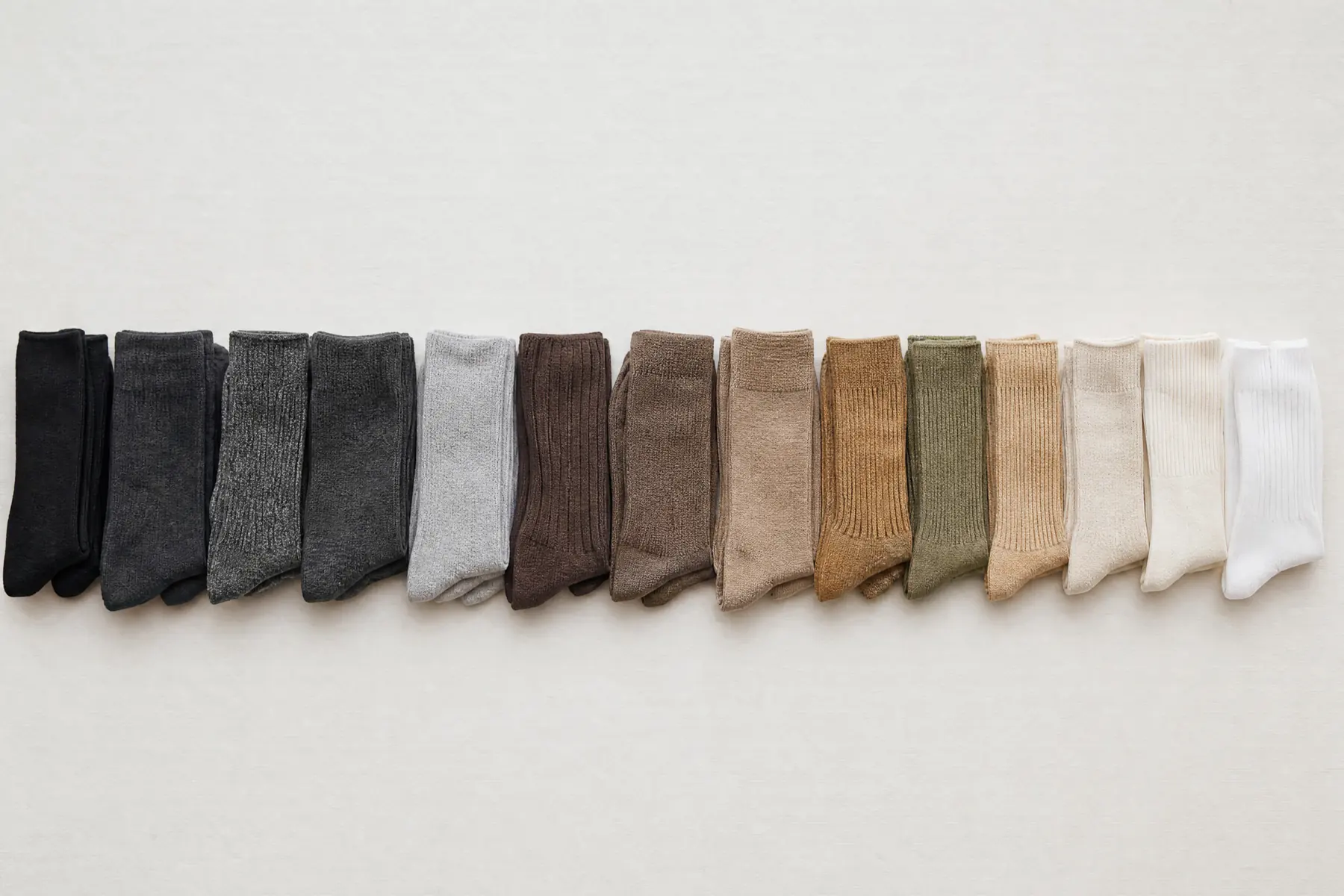
Betweenshoes assesses the colour continuity of trousers, socks and shoes as a sequence. It follows a long-standing convention of dress: that socks continue the trouser colour rather than echoing the shoe.
Where the sock sits close to the trouser in hue and in lightness, the eye travels from hem to floor without interruption. Where it sits closer to the shoe, an edge forms in the middle of the calf and the run is cut in two.
2. A convention, not a matter of right and wrong
This is a convention. It is not a matter of right and wrong.
Results are described as continuous or broken. They are never described as correct or incorrect, and the service passes no judgement on whether anyone is well dressed.
Deliberate contrast is an entirely legitimate choice. Wearing a sock that clearly does not match anything is a perfectly good way to dress, and the service will explain how to make it read as intentional rather than accidental. That explanation is part of every reading, not an afterthought attached to the ones we disapprove of — because we do not disapprove of any of them.
3. Where the convention stops
The convention has clear limits.
- It does not apply with shorts. There is no trouser above the sock, so there is no colour for the sock to continue. The sock is a free-standing item.
- It does not apply in sporting contexts. A sock is chosen there for cushioning, height and moisture, and those come first.
- Formal occasions carry stricter requirements. Black tie, in particular, has a fixed requirement of its own that supersedes any reading of continuity.
Beyond that, the specific expectations of any given occasion vary by region, by industry and by event, and are unknown to the service. For that reason the service states first whether the rule applies at all, and where it does not, it produces no verdict — because producing one there would be the most misleading thing it could do.
4. Where the model is used, and where it is not
An image recognition model is used for one task: reading each photograph and reporting the dominant colour, the lightness and the surface character of the item in it.
The model does not decide anything. Whether a sequence runs, where it breaks, whether the rule applies and what the exceptions are — all of that is calculated from a fixed table of rules and a fixed set of colour thresholds, and it is calculated in your browser. The numbers used are shown alongside every reading so you can see what produced it.
Where the service composes a written explanation, that text is generated from the calculated result, not the other way round.
5. What a photograph cannot tell us
Photographs carry a colour cast, and lighting changes the impression. Phone cameras set white balance independently for each shot, so three photographs of three items are three slightly different accounts of colour. The light where you actually stand shifts things again.
Where a case is close, judge it from the physical items. The screen is not the garment.
Every reading carries its own list of what it could not know, and that list is shown on every plan, including the free one, and is never covered by a watermark.
6. No people, no bodies, no appearance
The service accepts no photographs of anyone wearing clothing. Three flat photographs of three items, laid on a surface, is the whole of the input.
It generates no image of a person, a leg or a foot, and it gives no advice about body shape, proportion or appearance of any kind. The continuity it describes is a property of a colour sequence. It is not a property of anyone’s figure, and nothing here is about how anybody looks.
7. No products, no brands
No sock, trouser or footwear brand or product is recommended anywhere on this service. There are no shopping links, no affiliate arrangements and no sponsored placements. We sell a reading; we do not sell clothes and we are not paid by anyone who does.
8. Uses this service is not for
This is an information service about the colour of cloth. It must not be relied on for any decision in the following areas:
- medical or clinical decisions of any kind;
- legal advice or legal decisions;
- financial or credit decisions;
- safety-critical decisions;
- employment, recruitment or performance decisions;
- housing decisions;
- judicial or law-enforcement decisions.
The full list of restrictions is on the acceptable use page. If anything here is unclear, write to support@primehosiery.shop and we will explain it.